The Museum in Academia Sinica
Cultural Program
The Museum in Academia Sinica
March 13-National Palace Museum(*reserved for presenters and chairs )
March 15--One-day FreeCity Tour (*reserved for presenters and chairs )
March 15 night --TaipeiEye Theater(with English subtitle)
March 16-18 --Post-Conference 3 days-tour(March 16-18)
The Museum in Academia Sinica

March 15--One-day FreeCity Tour (*only reserved for presenters and chairs )
A. The Lin Family Mansion and Garden
The three courtyard House built from 1851, contents theaters, library, study rooms, exhibit room, gardens, in a total of 52 rooms, occupied in 5 acres; the house was constructed on a massive and splendid scale with beautiful elegant carving.
Pick up at Hotel 8:30
The Lin Family Mansion and Garden 9:00 – 10:30
B. Manka Area 10:50 – 12:00
Lungshan Temple and herbal medicine lane will take you back to the Taiwanse
way of life back in 250 years ago.
C. Lunch at “Taipei Mayor's Resident” 12:20 – 13:30
The “Resident” was a big Japanese style house which assigned to the Taipei Major’s Resident; however, present Major Ma has not moved in and instead,he changed the house into a restaurant.
D. Tataocheng Area 13:50 – 15:30
One of the oldest districts and trading port of Taipei City. Tihua Street is Taipei’s most largest wholesale and retail market of sundry goods including Chinese medicines and textiles. Confucius Temple is a very different temple from other Chinese Tao temples.
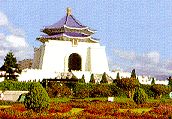
E. The Martyrs Shrine (忠烈寺) 16:00 – 16:30
Guard change ritual in 20 minutes is very interesting to watch.
F. Dinner and TaipeiEye Theater ( Theater ticket paid by participant)
March 16-18 --Post-Conference 3 days-tour(March 16-18)

Greetings all! Congratulation!
Now we have 18 participants said YES for post-conference tour.
We decided to go!
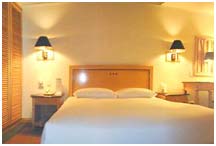
 Adult(single-room) Fare: 400usd. /per person
Adult(Twin-room) Fare:320usd./per person
*Twin Room: A room with two beds.
**If you would like to share your room with others, please let Eva know in advance. We could try.


Cancel before March 1st –you have to pay 40 usd additional for cancellation
Cancel after March 1st—the fee will be not refundable.
Payment: you could pay the tour fee by credit card (VISA or Master) after you arrived Taipei.
 Duration: 3days(March 16-18)
 Closing date--The cancel or change deadline: March 1st 2003
 If you have any special request for accommodation or food,
please let me know so that our travel agent could try to arrange it.
 Passport needed when taking airplane back to Taipei.
 If you wish to join this tour or have any questions ,please contact Ms. Eva Shih
  sleeping@gate.sinica.edu.tw
 Brief Post-Conference Tour Schedule
|
Date |
|
Tour |
|
March 16 Bus |
7:30 8:00
12:00
18:30 |
PICK-UP from Academia Sinica, Taipei arrived at San-hsia Tsushin Temple Taipei County Yingko Ceramics Museum and Pottery Street
LUNCH Pei-Pu Hakka small town 921 Earthquake Museum of Taiwan Taichung City Tour NIGHT Taichung The Landis Hotel
|
|
March 17 Bus |
7:30 9:30
12:00
14:30 18:30
|
GET-UP from Taichung /American Breakfast in Hotel Lukang Historic Area
LUNCH Lukang Ding-sam South Taiwan : Tainan and Kaoshiung NIGHT seafood and night market in Kaoshiung-Kaoshiung Top Plaza Hotel
|
|
March 18 Bus Airplane |
7:30 9:30
14:30 17:00 19:30 20:30 |
GET-UP from Taichung /American Breakfast in Hotel Meinong Folk Villiage(paper umbrella handicraft
Yellow Butterfly Valley Dinner in Kaoshiung Kaoshiung Airport Back to Taipei
|
Post-Conference Tour Introduction (March 16-18)
March 16
1.The San-hsia Tsushin Temple 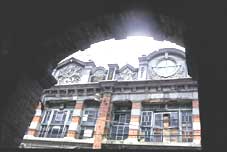
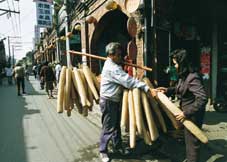
Sanhsia, a town known for its abundant produce and clear mountain springs, was formerly called "Sanchiaoyung." Because of its proximity to Tahan River, it once became a center of textile dyeing. Among its famous products were dyestuff, textiles, camphor and tea.
The Old Street of Sanhsia, lying west of the famous Tsushih Temple, has been well-maintained, including its Japanese colonial period architecture. Tsushih Temple, the center of religious life among early immigrants from Chuanchow, features elaborate carvings and paintings, which earned the temple another name--"Hall of Oriental Art."
2.Taipei County Yingko Ceramics Museum and Pottery Street
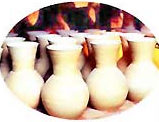
Yingko was already a famous production site for ceramics during the early Ching period.
Many ceramists and potters from Chuanchow, Fookien settled in what is now the Tahu District of Yingko.
From then on, the town has become associated with pottery and china, thanks to its soil suitable for
ceramic production.
If you take a stroll down the streets of Yingko, you will experience a way of life shared by all people over thousands of years through ceramic creations, be they colored vases, interesting figurines or incense burners. The Taipei County Government has set up the Yingko Pottery and China Museum as a way to introduce ceramic art in Taiwan, and to showcase and promote Taiwanese culture through exhibitions and other large-scale activities.
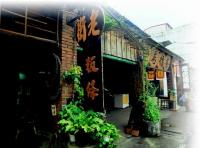
Peipu is the last one to be developed in this county. Originally its name was Peipu Nanhsin Village. Its special immigrants (warriors) background and Hakka culture formed an unique ethnic culture of Peipu. In Fengshuei, we are very concerned about hiding the wind and gathering the air; in the defense, we pay a great attention to multi-shield defense. The developers of early period created an excellent effect of defense function by building up bamboo bushes, front doors, ponds and winding alleys or lanes. Those important buildings in Peipu village are based on Shuoluan Mountain. Under a planning on the whole scale, there are different functions.
4.The 921 Earthquake Museum of Taiwan
About the Disaster: ▼
|
ate: September 21st, 1999 |
|
Time: 1:47 a.m. |
|
Location: central Taiwan |
|
Depth of rupture: 8 km. |
|
Magnitude: 7.3 on the Richter scale. |
|
Death toll: 2,471 |
|
Seriously Injured: 11,305 |
|
House Collapsed: about 51,000 |
|
House Semi-collapsed: about 53,000 |
|
Damage of Public Works: infrastructure such as power, water, roads, bridges, tele-communication railway, historical buildings and schools were severely damaged. |
|
Estimated Total Loss: about NT$ 360 billion |
5.Taichung City
Taichung City is located in the heart of the central part of Taiwan. Taichung has become a major transport hub with excellent transportation links to both the metropolitan areas of Taipei in the north and Kaoshiung in the south.Taichung used to be named "Tatuen", and the city was established 300 years ago. Now the city is entering the democratic era. The city is divided into eight districts, including East, West, South, North, Peitun, Nantun, Hsitun, and Central District. Every district has one leader with some 14,000 government officials all together working for the city government administration.
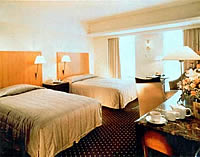
6.Taichung The Landis Hotel

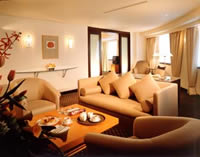
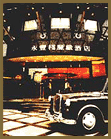
March 17
7.Lukang Historic Area
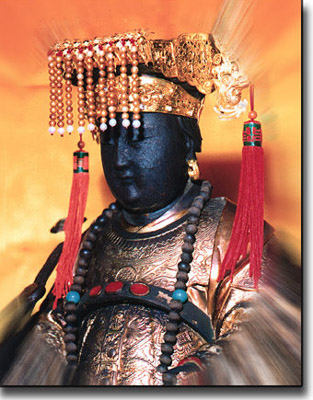 The Chinese 「一府、二鹿、三艋舺」 means Lukang is the second largest town in Taiwan. The history of the town of Lukang has been characterized by rapid change. In the 17th century, Dutch occupiers used Lukang as a major harbor for exports; in 1784 it was designated as the Taiwan seaport for shipping links with the Hanchiang harbor at Chuanchou on the coast of mainland China. Thereby becoming the gateway to central Taiwan. At that time the town was crowded with stores that covered their facing streets with awnings, creating the famous 「no sky」market areas.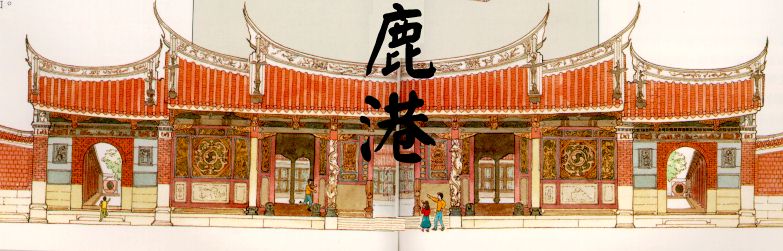
Early in the present century the conservative residents refused to allow the passage of major northsouth railways and highways, and the harbor silted up as well, reducing Lukang from the second largest city in Taiwan to a small back water town. It is this conservatism,too, that has allowed the preservation of the traditional face of Lukang. Once you come to Lukang, you will soon realize what a charming town. Everyone in Lukang, will extend to you our warmest hospitality.--Lukang town mayor, Huang Chen-Long
8.Tainan : remains of Taiwan Early City
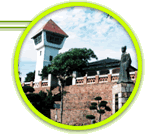 In the late years of the 17th century, the tides of western colonialism came ashore onto the coasts of China. The Dutch invaded and seized An-Ping as a military and commercial base in 1624.They began to construct a fort named Fort Zeelandia, which was completed in 1634. Because Cheng Cheng-Kung and his son resided in the fort during the Ming dynasty, it was also called "Imperial Castle", "An-Ping Fort" or "Taiwan City".In the wake of the Taiwan Retrocession, the fort was reconstructed and called "An-Ping Fort".The only remains of the Dutch-built Fort Zeelandia are two semi-spherical fort fragments on the platform north of the fort and part of the outer wall along the road in front of the fort. An old banyan tree clinging to the outer wall has witnessed the various historic changes of the fort over the past 300 years.
9.Kaoshiung City
Kaohsiung is the biggest commercial harbor and the second biggest city in Taiwan. Besides, the cargo volume she handles Kaohsiung harbor ranks third in the world. Kaohsiung is situated on the southwest cost of Taiwan. It is long from south to north, and comprises an area of 153.6-sq. km. divided into 11 districts. It was elevated as a Special Municipality on July 1, 1979. Kaohsiung has a population of 1.46 million, and half of it is labor. Kaohsiung is the chief center of the heavy industry and petrochemical industry. Lin-Hai industrial district, China Steel Corporation, China Shipbuilding Corporation, along with the Linyuan Petrochemical Industrial Complex all have their home in the city, and have greatly contributed to Taiwan’s economic wonder.
Kaohsiung Harbor, the best and the biggest seaport in Taiwan, occupies nearly 27 sq. km, with a shipping channel of 18 km. in length. The harbor contains 106 berths, 5 container terminals, which allows ships under 100,000 DWT to navigate, and 145 ships to berth simultaneously. The Kaohsiung Airport accommodates all kinds of aircraft including 747-400 to berth the opening of the New International Terminal. Passenger traffic has increased to 7,000 person-trips every day, 2,555,000 every year. So far 15 airlines offer international routs. Kaohsiung has more than 20 sister cities. Every year, many activities about culture, arts, sports, industry and business are held among these cities. It spares no effort in promoting visits and economical exchanges with foreign cities in order to elevate its international status.
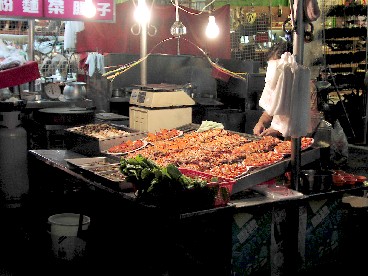
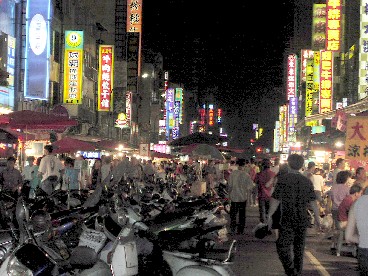 The Liu-Ho Night Market
located in the center of downtown, about 10 minutes walk to the Kaohsiung Railway Station, with 138 pitches opening all night long, is the most significant and fascinating sight in the Kaohsiung metropolis for over 50 years.
Since 1949,there had already been sprinkling pitches gathered here in the Liu-Ho 2nd Road. The government of Kaohsiung City established a temporary concentration area for pitches in 1962. And further in 1987, the government began practicing "pedestrian walk" (which all vehicles are banned from entering) during the business hour from 18:00 to midnight. Today, the Liu-Ho Night Market has become a very famous sight in the Kaohsiung city. It's not only a good place for citizens' daily diet, but a great gourmet paradise for people from all the island, even from other countries, to enjoy the civic life pleasure
10.Kaoshiung-
March 18
11.Meinong Folk Villiage(paper umbrella handicraft)
|
Romantic Art |
|
Taiwan News 編輯部 |
 The Starting
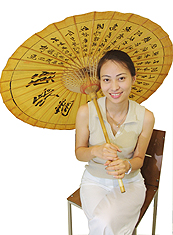
Umbrellas, "San", have had a long history in Chinese heritage and often evoke special sentiments. Umbrellas in China evolved from the concept of "Gai" - Cover. Ancient scriptures explained "cover" as a device used to shade sunlight and rain and which can be opened and retracted for storage. In ancient China, the roofs of kings and royalties' carriages were in the form of an umbrella. These "roofs" were later transformed into hand carry paper umbrellas.
In Meinong, paper umbrellas were introduced into this region around eighty years ago during the Japanese Colonization time. Two stories have been passed down about the origins of the famous Meinong paper craft. First, it was said that Meinong local folks Lin A Gui and Wu Zhen Xing hired a Chinese umbrella-making master to teach this craft to locals out of necessity. Another story suggested that the craft was brought in by an umbrella-making master from Mei County in Guang Dong, China (origin of many Hakka in Taiwan) who crossed the Taiwan Straight and settled in Meinong. Because of his mastery in paper umbrella making, the seeds of Meinong's famous paper craft was sawn and flourished for years to come.
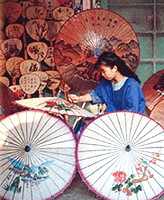
Umbrellas play a very important role in Hakka families' daily lives. Other than being used as shades, they are also symbols of good fortune. In Hakka language and customs, "Zhi" (paper) pronounces the same as "Zi" (children); for that reason, Hakka folks always include a pair of umbrellas in the bride's trousseau to bless the newly weds for the fortune of having children soon. "San" (umbrella), the word is a pictograph composed with five people "Ren" under a cover which symbolizes blessings for having many children. Moreover, the top of an umbrella is round "Yuan" which symbolizes completeness and "Yuan" (pronounced same as "Yuan" for completeness) for luck that brought people together. Meinong paper umbrella factories very often hold paper umbrella painting tutorials and activities to spread the culture of this beautiful craft. Meinong paper craft, with its special mysterious flair of the East, captures the beautiful folk culture and natural art form on the surfaces of umbrellas.
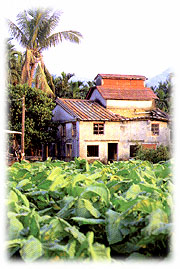
In earlier times, Meinong paper umbrella factories were mostly named with the word "Guang" meaning wide an vastness and also "Guang" Dong province in China where some Taiwan Hakka were originated. For examples, a few famous factories were Guang Zhen Xing, Guang De Xing, Guang Rong Xing, Guang Mei Xing, etc. Before the 1960's paper umbrella and tobacco were the two major sources of income for the Meinong Town. At its peak, twenty thousand umbrellas were sold each year yielding more than forty million New Taiwan Dollars in production value. Later on, since Taiwan's manufacturing industry started to take off and became the empire of mass produced nylon umbrellas, while earning a substantial amount of foreign currencies, these cheaper and more durable products rapidly replaced the functions of paper umbrellas. Fewer and fewer factories could afford to fight this revolution; in result, many of them were forced to close down. Copyright 2002 Council for Hakka Affairs, Executive Yuan
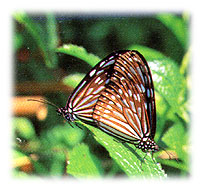
 12. Yellow Butterfly Valley
Dinner in Kaoshiung
Kaoshiung Airport
Back to Taipei